
Day-by-day itinerary
EASTER CRUISE 2027 — GREEK ISLANDS AND KUŞADASI
Cruise group with a tour leader from Bulgaria
Experience the magic of the Aegean Sea on our unforgettable Easter cruise, taking you to four of the most beautiful Greek islands and Turkey’s enchanting coastline. Begin your journey on cosmopolitan Mykonos, where charming cobbled streets, iconic windmills and white houses will captivate you with their authentic charm. Continue to the Turkish coast at Kuşadası, the gateway to ancient Ephesus, one of the world’s most impressive archaeological wonders. The next stop is Patmos, known as the “Island of the Apocalypse”. Visit the Monastery of St John and the cave where, according to tradition, the Apostle John received his revelation. Enjoy the tranquillity and mystique of this sacred place. On Crete, the largest Greek island, discover a rich history and culture. Visit the Palace of Knossos and delve into the mysteries of the Minoan civilisation, while also enjoying Crete’s culinary delights. The cruise ends with a visit to wonderful Santorini, renowned for its white domed buildings contrasting with the azure sea. Admire breathtaking sunsets and explore the island’s unique volcanic nature. This cruise combines history, culture and astonishing natural beauty. Discover Greece’s magical islands, where each stop tells its own ancient tale. Join us for an unforgettable Easter adventure filled with beautiful sunsets, exotic flavours and happy memories to treasure for a long time.
5 days / 3 nights
Route: Sofia – Lavrion – Mykonos – Kuşadası – Patmos – Heraklion /Crete/ – Santorini – Lavrion – Thessaloniki – Sofia
Departure date: 29.04.–03.05.2027
ITINERARY
Programme highlights:
Visit 4 of the most beautiful Greek islands on a single sailing: Mykonos, Patmos, Crete and Santorini.
Visit to Kuşadası /Turkey/ with the option of an excursion to Ephesus.
All port charges and onboard service charges included.
Transport by licensed coach to and from the port in Athens.
Full board on the ship, with drinks during meals.
Entertainment programme and opportunities for spa treatments and relaxation on the newest ship in the Celestyal Cruises family.
Extensive excursion programme, with optional shore excursions available every day.
Visit to Thessaloniki, the principal city of the Macedonia region.
Tour leader from Bulgaria.
Day 1 /29.04./: SOFIA – LAVRION
Departure from Sofia in the early evening from the Vasil Levski Stadium car park towards the port of Lavrion /Greece/, following the route Sofia–Sandanski–Kulata–Thessaloniki–Larissa–Lamia–Lavrion. Arrival at the port in the morning.
Day 2 /30.04./: LAVRION — sailing at 13:00
At the time announced by the cruise company, check-in for the cruise aboard Celestyal Discovery. Sailing from Lavrion at 13:00. Your idyllic escape into the Aegean Sea begins here. The Aegean Sea, also known in Bulgarian as the White Sea, is a semi-enclosed sea forming part of the Mediterranean. It occupies land that was submerged at the end of the Pliocene, between the Balkan Peninsula, Asia Minor and Crete. It connects to the Sea of Marmara through the Dardanelles. Its total length is about 610 kilometres, its width up to 300, and its area 240,000 sq. km. Its deeply indented coastline forms numerous gulfs, peninsulas and islands, as well as small internal seas. The main peninsulas extending into the sea from the Balkans are Akte, Attica, Magnesia, Halkidiki and Gallipoli; those from Asia Minor are Çeşme and Reşadiye. The Argolic, Saronic and Volos gulfs lie in central Greece, while Halkidiki is surrounded by the Thermaic and Strymonian gulfs; its own peninsulas form two more deep gulfs, Kassandra and Singitikos. Further east is the Gulf of Saros, while the Asia Minor coast forms the gulfs of Edremit, Izmir, Kuşadası, Mandalya and Gökova. The southern Aegean, washing the shores of Crete, is known as the Sea of Crete, while the northern part, between Halkidiki and Gallipoli, is known as the White Sea. The White Sea is characterised by its many islands, estimated at 1,415, only 20 of which do not belong to Greece. The largest is Euboea /Evia/, covering 4,165 sq. km. Other large islands are Chios, Lesbos, Thassos, Naxos, Rhodes and Samos. The islands form four smaller archipelagos: the Cyclades, the Saronic Islands, the Southern Sporades (Dodecanese) and the Northern Sporades. The remaining islands are classified as the North Aegean Islands. The sea’s average depth is 1,200 m. Its deepest parts are the bed of the Sea of Crete near Karpathos, 2,591 m (maximum depth), and the trench south of Halkidiki, up to 1,575 m deep. It is a saline sea, with salinity up to 38 parts per thousand, and tides do not exceed one metre. The main ports are Piraeus, Thessaloniki and Izmir. There are numerous shipping and ferry connections between the islands. All sea routes to Russia, Bulgaria and other Black Sea countries cross it. Since antiquity, various explanations have been proposed for its Greek name, Aegean. Some derive it from the city of Aegae; others from Aegea, queen of the Amazons, who died in the sea. Others favour the legend that the sea was named after King Aegeus, father of Theseus, who threw himself into it believing that his son had died. Most likely, the Greek name derives from the ancient Greek word aiges, meaning large foaming waves. Two great civilisations of enormous significance to the region arose here: the Minoan civilisation on Crete and the Mycenaean civilisation on the Peloponnese. Centuries later, the city-states of Athens, Sparta and many others that created Hellenic civilisation and ancient culture were also founded here. The Aegean was later ruled by Persia, Ancient Rome, the Eastern Roman /Byzantine/ Empire, Venice and the Ottoman Empire. In modern times, Bulgaria also had access to the White Sea between 1912 and 1918, and again between 1941 and 1944 during the Second World War, when it also controlled two Aegean islands, Thassos and Samothrace.
MYKONOS — 18:00–23:00
Mykonos is Greece’s most cosmopolitan island, where people from all walks of life and cultures meet to create an optimistic atmosphere expressed in extraordinary abundance and liveliness. Amid the azure waters of the Aegean, it attracts the world’s most famous people every year. Over the years, even if only for a day or two, visitors have included Claudia Cardinale, Jean Paul Gaultier, Jacqueline Kennedy Onassis, Ted Turner and Jane Fonda. The sophistication of Mykonos is evident in the high-end boutiques, contemporary art galleries and chic gourmet restaurants, found mainly in Mykonos Town. VIPs and celebrities have made the island a favourite stop while sailing the Aegean on their luxury yachts. The town’s greatest monument is the Church of Paraportiani, dating from the 16th–17th centuries and built in a unique asymmetrical architectural style. The archaeological, maritime and folklore museums in Mykonos Town display excellent collections of historical artefacts and are well worth visiting. You could easily spend your port day simply exploring Mykonos Town and its surroundings at a leisurely pace, wandering winding narrow streets and shopping. There are hundreds of shops, from small souvenir stores to high-end designer boutiques and everything in between.
The 16th-century Tourliani Monastery is one of the oldest monasteries in the Cyclades island group. It is famous for its beautiful carved wooden altar screen, made in Florence in the 18th century, and contains several exquisite ecclesiastical artefacts, including a miraculous icon of the Virgin Mary believed to be the work of the Apostle Luke. Do not miss a photo beside Mykonos’s emblem, the three windmills standing like sentinels over the charming town.
Optional excursion: MYKONOS AND LITTLE VENICE
Day 3 /01.05./: KUŞADASI /TURKEY/ — 07:00–13:00
Kuşadası is a city in western Turkey on the Aegean coast, about 90 km south of Izmir. One of the most popular resorts in Aegean Turkey, it enjoys sunshine almost 300 days a year. It is known for its mild climate, beautiful beaches and cultural heritage. Kuşadası was an important ancient city ruled by many civilisations and empires, including the Lydians, Persians, Romans and the Ottoman Empire. Its major sights include one of the world’s largest Roman city agoras, with many surviving Roman pillars and columns. The Turkish name Kuşadası literally means “island of birds” or “bird island”. This reflects the many bird species that have lived here over the years, including pelicans, gulls and others. The name may also refer to the small island off the coast, home to many resident and migratory birds. Kuşadası is also renowned for its beautiful beaches, including Long Beach, Kadıkale and Ladies Beach. Its climate is typically Mediterranean, with mild winters and warm summers. The summer season runs from May to October, when temperatures range from 25 to 35 degrees. Here you have the opportunity to explore the iconic ruins of ancient Ephesus. Before returning on board, feel free to browse the souvenir stalls in the covered market near the port.
Optional excursion: ANCIENT EPHESUS THROUGH THE AGES — HELLENISTIC AND ROMAN PERIODS
PATMOS — 16:30–21:30
Patmos is the smallest of the Dodecanese, a group of twelve Greek islands also known as the Southern Sporades. It covers 28 sq. km. Like the other islands (Rhodes, Samos, Kos and others), it has a Mediterranean climate. The inhabitants traditionally make a living from tourism and sponge diving, and to a lesser extent farming and fishing. Its main town is also called Patmos. The most important event in the island’s cultural history was the exile of John the Theologian here around AD 95. According to tradition, it was on Patmos that he wrote two important parts of the New Testament: one of the four canonical Gospels, the Gospel of John, and Revelation. There is a cave on the island where, according to tradition, John wrote these books of the Bible. An ancient monastery stands at the highest point of Patmos, with a rich library that local monks say was also visited by Bulgarian clerics in the 17th century.
Patmos is a charming, picturesque and peaceful island. It has a very pleasant climate and a clean atmosphere. Vegetation is rather sparse, but this in no way diminishes the beauty of its intricate coastline, charming bays and surrounding islets. Far from mass tourism, Patmos is ideal for those seeking alternatives. The combination of spirituality, wild unspoilt nature and 20th-century tourism makes it a unique place that draws many visitors back again and again.
Visit the fortified town of Chora. Its quaint whitewashed houses, separated by narrow streets and quiet shady squares, date from the Middle Ages. Enjoy a visit to an authentic Greek shop or taverna, or take a detour for a closer look at the forlorn windmills.
Optional excursion: ST JOHN’S MONASTERY AND THE CAVE OF THE APOCALYPSE
Day 4 /02.05./: HERAKLION /CRETE/ — 07:00–12:00
Heraklion is Crete’s principal city. Unlike most major Greek cities, it dates not from antiquity but from the 9th century, and was founded not by Greeks but by Saracens expelled from Andalusia by the Emir of Córdoba. It has been ruled by Byzantines, Arabs, Venetians, Turks, Egyptians and Greeks. This mixture of cultural influences has created a unique cultural atmosphere: some places evoke Italy, others Asia Minor, and others Greece. About 6 km from the city lies Crete’s greatest attraction, the Palace of Knossos, associated with the legends of Daedalus and Icarus and the Minotaur’s labyrinth, and the home of King Minos, considered the father of Western European civilisation. Another major sight is Heraklion’s Archaeological Museum. Its 20 halls display the world’s largest collection of Minoan art, complemented by masterpieces from the Dorian, Classical and Greco-Roman periods. Here you can see the famous Phaistos Disc, whose symbols resemble a script that has not yet been deciphered. Equally famous are the figurine of the Snake Goddess, the bull’s-head rhyton, the frescoes brought here from the Palace of Knossos and other exhibits.
The city’s core is still enclosed and defined by the Venetian wall, which includes seven projecting bastions. At its southernmost bastion, Martinengo, is the tomb of Nikos Kazantzakis on a windswept hill, bearing the moving inscription: “I hope for nothing. I fear nothing. I am free.”
If history is not to your taste, stroll along Odos 1866, the street hosting the open-air market. The stalls are piled with everything: seasonal fruit and vegetables, clothes, souvenirs, thyme-scented honey, dried herbs and teas, olive oil and olive-oil-based cosmetics, and pumice.
Optional excursion: PALACE OF KNOSSOS — EUROPE’S FIRST CIVILISATION
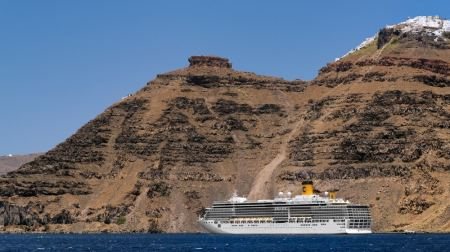
SANTORINI — 16:30–21:30
Santorini is one of the most popular and most visited Greek islands. Located between Ios and Anafi, it is renowned for its beautiful architecture, incredible views from sheer cliffs, colourful beaches and stunning sunsets. The volcanic island acquired its present shape after a powerful eruption around the 17th century BC. Nea Kameni, one of the islands in the Santorini group, is the remnant of an active volcano that you can climb, as well as bathe in the hot springs. Excavations at Akrotiri have confirmed that people have inhabited the island since ancient times, although for several centuries after the eruption it was empty and uninhabited. The island’s official name is Thira, and its main town, Fira, is also the capital of the Cyclades. The locals live mainly from agriculture and tourism. Santorini offers some of Greece’s most expensive hotels, attracting wealthy and famous people from around the world. You can explore as part of an organised cruise excursion or independently, using local transport, a rental car, scooter, bicycle or taxi. Tender boats generally bring cruise passengers ashore at the small port linked to Fira and the rest of the island by a steep winding path and a cable car.
Santorini’s best-known attraction is the village of Oia at its northern tip. People come from all over the world to savour its peaceful life and fantastic sunsets. The village stands atop an impressive sheer cliff and offers incredible views of Palea Kameni, Nea Kameni and Thirassia. Another place to visit is Akrotiri, an ancient city buried by the volcanic eruption 3,500 years ago. Archaeologists are still excavating it, but you can walk along its small neighbourhood streets and see the buildings almost as they were centuries ago.
Santorini’s shops, especially those in Fira, will certainly tempt you. As you walk through Fira’s narrow cobbled streets, the shop windows are sure to catch your eye. Local souvenirs, jewellery, pastry shops, ice cream, eateries and Ypapantis Street, known as the “Gold Street”: this is thought to be one of Greece’s largest gold markets. Traditional dishes such as tomato fritters, Santorini salads, peas, white aubergine, stuffed round courgettes, omelettes, boiled capers, fresh cheese and local specialities including apoksi (a type of cured ham), sausages, wild rabbit in a cheese-and-egg sauce, brantada, sweet melitinia and saffron rusks all express the rich and varied cuisine of the island’s culture. Do not miss the special local wine, produced from vines growing in sandy volcanic soil, which gives it a very distinctive taste.
Optional excursion: SUNSET OVER OIA ON THE EDGE OF THE CALDERA
Day 5 /03.05./: LAVRION /GREECE/ – THESSALONIKI – SOFIA — docking at 06:00
Our epic journey ends where it began, on the Greek coast. Disembarkation and collection of luggage. Departure for Bulgaria. En route, a stop of about 2 hours at the White Tower in Thessaloniki for independent activities: a rest, a meal or shopping. The White Tower, also known as Lefkos Pyrgos, is an iconic monument on the Thessaloniki waterfront in Greece. Originally built as a fortification in the 15th century under Ottoman rule, it was later used as a prison and place of torture during the Greek War of Independence. Eventually it was renovated and turned into a museum dedicated to Thessaloniki’s history. It also offers wonderful views of the city and the Aegean Sea. If the museum is open, admission is €6 for adults, €4 for students and free for children under 18. Other ways to spend the time include a walk along the waterfront Nikis Boulevard with its many eateries, or Tsimiski shopping street. Visit the city’s main square, Aristotelous, or the well-known Thessaloniki market nearby. After the break, departure for Sofia. Arrival at the Vasil Levski Stadium car park late in the evening.